

A few weeks ago I published an article on iron absorption, and I promised myself (and you) that yellow dock would be next. It felt like a natural follow-up as yellow dock is one of the most consistently recommended herbs for iron deficiency in Western herbalism, and I figured I’d dig into the research, pull together the mechanisms, and put out a solid companion piece. Easy peasy.
That is not what happened.
What happened instead is that I started pulling on the thread of the iron claim and kept finding things that didn’t quite add up. The plant contains iron, yes, but it also contains tannins that bind iron in the gut, and oxalates that do the same thing. Then I found a pilot study that actually tested a commercial Rumex crispus preparation for iron content, the result stopped me completely: no detectable iron in the preparation at all. The herb that built its entire reputation on blood building was delivering none of it under standard therapeutic conditions.
What gives?
So, I kept digging, and the more I dug, the more I realized that the real story of yellow dock isn’t about iron content at all. It’s about what the plant does to the digestive environment that determines how well your body absorbs iron from everything else. That’s a genuinely different mechanism than what most herbalism resources describe, and it turns out to be a far more interesting one.
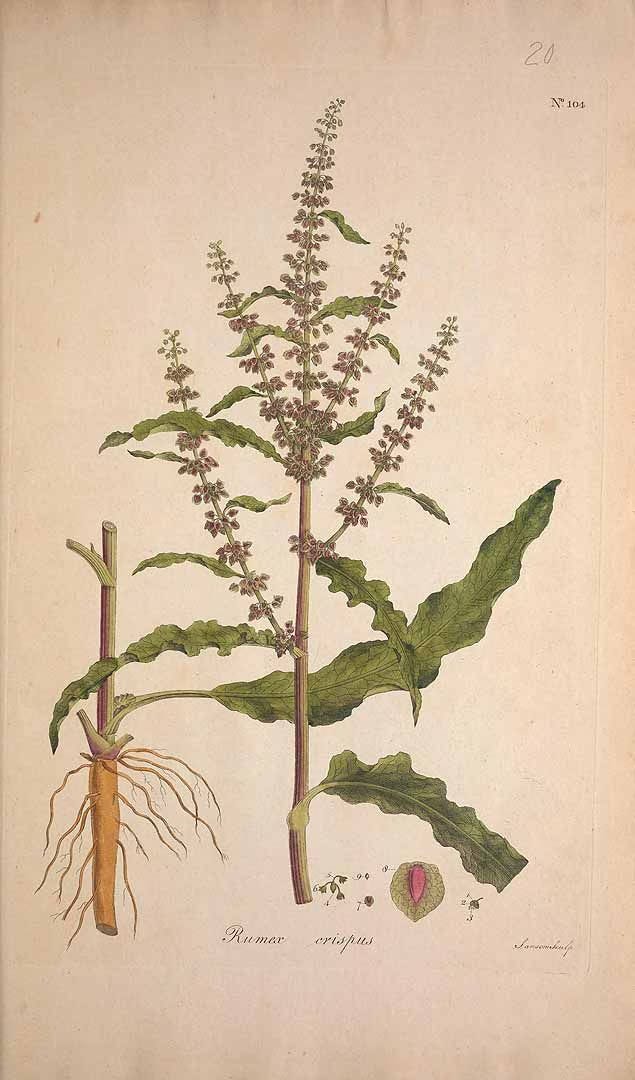
Rumex crispus is not the prettiest plant out there.. It grows where it’s not invited: beside cracked asphalt, along drainage ditches, at the edges of fields where the soil has been turned and left. Its leaves curl at the edges like pages left in the rain. The root drives straight down into clay, staining the hands golden-orange when freshly cut. There’s nothing delicate about it. It simply grows, year after year, in the places where other things have given up.
Herbalists call it a weed teacher for exactly that reason, and after everything I found while writing this article, I think that label fits in more ways than one.
What follows is everything I uncovered: the history, the phytochemistry, the research that exists and the research that doesn’t, and the mechanism that finally made the traditional use make sense. It’s a longer read than I planned, and it went somewhere I didn’t expect. I think you’ll find it worth the time.
Detective Agy was on the case!

A History of Roots: Yellow Dock Through the Ages
Yellow dock belongs to Polygonaceae, the buckwheat family, sharing lineage with sorrel, rhubarb, and knotweed. Its native range stretches across Europe and western Asia, but it followed human disturbance so reliably that it now grows across most of North America, Australia, and parts of South America (Qian et al., 2024). You will find it at roadsides, in overgrazed fields, along stream banks, wherever the soil has been turned and left to recover on its own terms. Herbalists call it a weed teacher for exactly that reason. It shows up where it is needed, without being asked.
The root is the primary medicine, harvested in autumn when the plant’s energy is drawn downward and the concentration of active constituents is at its highest. The leaves have a long history as a cooked green across multiple food cultures, though they carry a higher oxalate load than the root and have traditionally been used with more caution.
A Plant With a Long Memory
One of the more interesting things about Rumex crispus is how consistent its medicinal reputation has been across cultures that never had contact with each other. Traditionally, it has been documented as an astringent, laxative, diuretic, mild tonic, blood cleanser, and cholagogue across Asia, Europe, and the Americas (Qian et al., 2024). That last term, cholagogue, simply means a substance that stimulates bile flow, and it will become important when we get to the mechanism section. For now, what is worth sitting with is the cross-cultural consistency itself. When different traditions arrive independently at the same uses for the same plant, it is usually a signal that something real is happening in the body.
Indigenous nations across North America worked with yellow dock long before European contact. Several eastern tribes used the root as an astringent and topical remedy for skin irritations and sores, while other nations prepared root washes for more chronic skin conditions. The Cherokee used it internally for sluggish digestion and what Western herbalism would later describe as hepatic congestion (Qian et al., 2024). These are not scattered or isolated observations. They reflect a pattern that points consistently toward the liver, the gut, and the skin as yellow dock’s primary territory, which is exactly where modern phytochemistry would eventually place it too.
When European settlers arrived in North America, yellow dock was not an unfamiliar plant to them. The Old World pharmacopoeia had long used Rumex species for constipation, jaundice, and skin disease, so the plant moved across continents carrying a reputation that both traditions already recognized independently. It was bitter, clearing, and persistent, and those qualities translated across every context it entered.
The Eclectic Physicians and the Alterative Framework
The Eclectic physicians of the 19th century gave yellow dock some of its most detailed clinical documentation, and it is worth taking a moment to understand the framework they were working within, because the word they used gets thrown around loosely in modern herbalism.
An alterative, in the Eclectic sense, was not a herb that treated a specific symptom. It was a herb that seemed to shift the body’s overall metabolic current over time, gradually clearing conditions that had accumulated slowly: chronic skin eruptions, iron-deficiency presentations, hepatic sluggishness, persistent lymphatic congestion. The idea was less about targeting a problem and more about changing the internal environment that allowed the problem to persist. Felter and Lloyd’s King’s American Dispensatory described yellow dock as a gentle but persistent tonic with a particular affinity for the liver and digestive organs, and made a point of noting that its laxative action could not really be separated from its tonic one (Felter & Lloyd, 1898). The two were considered part of the same medicine.
That observation has held up remarkably well. As we will see in the phytochemistry section, the same compounds driving motility are also supporting bile flow and liver function. The Eclectics did not have the biochemistry to explain why those actions were inseparable. They just noticed that they were, which is often how the most durable clinical observations get made.
Yellow dock has moved through centuries of use carrying the same essential reputation: a plant that moves what is stuck, whether that is bile, bowel, blood, or the kind of slow metabolic depletion that builds quietly before anyone thinks to look for it. That consistency is part of what makes it worth understanding properly.
What Is Inside the Root
Yellow dock root contains several distinct groups of active compounds, each contributing something different to the plant’s overall character. A 2024 comprehensive review identified over 224 constituents in R. crispus, which gives you a sense of how chemically complex this root actually is beneath its unglamorous exterior (Qian et al., 2024). What follows are the groups that matter most for understanding how it works, and why the iron story is considerably more interesting than most articles let on.
Anthraquinone glycosides are the root’s most pharmacologically active constituents, and the source of that characteristic golden-orange color when you cut fresh root or hold a good tincture up to the light. Emodin, chrysophanol, and physcion are the primary forms (Qian et al., 2024). They act on the large intestine by stimulating peristalsis and inhibiting water reabsorption from the colon, a mechanism involving mucosal irritation and activation of the enteric nerves that drive motility. The result is a mild but reliable laxative effect, gentler than senna or cascara but operating through the same basic pathway. As we will see in the mechanism section, this action is not incidental to yellow dock’s reputation as a blood-building herb. It is central to it.
Tannins are present in significant quantities, and this is where things start to get a little more complicated than the standard yellow dock story lets on. Tannins are polyphenols with strong protein-binding and astringent properties, and they are well-documented inhibitors of non-heme iron absorption. They bind iron in the gut before it can cross the intestinal wall and enter circulation, forming insoluble complexes that pass out of the body rather than into the bloodstream (Hurrell & Egli, 2010). This is the same reason a cup of black tea alongside an iron-rich meal is not a great idea. It is worth sitting with that fact for a moment, because it sits in direct tension with the herb’s iron-building reputation, and that tension is exactly what makes the plant interesting.
Oxalates add another layer to the same picture. Yellow dock contains both soluble and insoluble oxalates, and the soluble fraction binds divalent minerals including iron, calcium, and magnesium in the intestinal lumen, reducing their absorption. The oxalate content in a standard therapeutic dose of root tincture is modest enough that it is not clinically significant for most people, but it is real, and for individuals with specific vulnerabilities it matters. We will come back to this in the safety section.
Flavonoids and other polyphenols round out the picture. Quercetin and kaempferol are the most studied flavonoids in Rumex species, both with antioxidant and mild anti-inflammatory properties. Quercetin has been studied for its inhibitory effects on enzymes involved in carbohydrate digestion and inflammation, and the broader flavonoid profile contributes to the slow, systemic liver-supporting action that sits at the heart of the alterative framework (Qian et al., 2024). Nepodin, a stilbenoid compound isolated from the root, has attracted interest for antimicrobial and antiproliferative activity in laboratory models, though that research is still early stage.

Rumex crispus taproot
So, about that iron…
I want to be honest with you here, because when I went looking for the evidence behind one of the most repeated claims in popular herbalism, what I found completely stopped me in my tracks.
Yellow dock root does contain non-heme iron. Mineral analysis has measured the root at approximately 32.95 mg per 100g of dry weight, which sounds meaningful until you account for a few things (Qian et al., 2024). First, a standard tincture dose delivers only a small fraction of that total. Second, the tannins and oxalates present in the same root actively inhibit mineral absorption in the gut, working directly against any iron the root might be contributing. And third, when Burgess and Baillie actually tested a commercial Rumex crispus fluid extract in a pilot study, they found no detectable iron in the preparation at all (Bergner, n.d.).
Let that land for a second. The herb that built its entire reputation on iron was delivering none of it in its standard therapeutic form.
The study also found that Rumex taken alone not only failed to improve iron parameters in participants, it actually worsened four of the five blood markers measured, including serum hemoglobin and ferritin. That is a genuinely uncomfortable finding for anyone who has ever taken this herb seriously.
But here is where it gets interesting again (sorry for the whiplash!): Rumex combined with molasses outperformed molasses alone. Something the plant was doing improved how the body responded to an external iron source, even when the plant itself was contributing zero iron to the equation.
That finding points directly toward a physiological mechanism that has nothing to do with iron delivery and everything to do with the digestive environment. To understand it properly, we need to talk about what yellow dock is actually doing in the gut, which is the whole next section.
But the short version is this: yellow dock’s anthraquinones stimulate bile flow from the gallbladder into the small intestine, and bile is essential for creating the absorptive conditions that allow nutrients, including iron, to cross the intestinal wall efficiently. The motility action keeps intestinal transit time appropriate so the absorptive surface of the upper gut is functioning well. And the bitter compounds support overall hepatic function in a way that shifts the metabolic environment over weeks of consistent use.
Once you shift the question from "how much iron does this plant contain" to "what is this plant doing to help the body absorb iron," the whole picture changes. That is the more useful question, and yellow dock has a very good answer to it.
The rest of this article is for paid subscribers.
Below, we get into the part that completely reframed how I think about this herb. We cover what a pilot study found when it actually tested a commercial yellow dock preparation for iron content, why the result was so unexpected, and what it tells us about the mechanism that has been driving the traditional use all along. We also break down exactly how yellow dock primes the digestive environment for iron absorption through bile flow, gut motility, and the migrating motor complex, why timing your preparation matters, what the full research picture actually looks like, and everything you need to know about safety and drug interactions before recommending or using this herb.
As a paid subscriber you also have access to The Library, a growing collection of materia medica, practical guides, and a body systems index you can actually use in your practice, plus Field Notes, the short-form weekly series (every Tuesday!) where I break down one focused concept, one mechanism, one plant, in a format you can read in five minutes and carry into your week. :)